
PDF Download Shooting Movies Without Shooting Yourself in the Foot: Becoming a Cinematographer
Starting from seeing this website, you have aimed to begin caring reviewing a publication Shooting Movies Without Shooting Yourself In The Foot: Becoming A Cinematographer This is specialized site that market hundreds collections of books Shooting Movies Without Shooting Yourself In The Foot: Becoming A Cinematographer from whole lots resources. So, you will not be tired more to choose the book. Besides, if you likewise have no time to search guide Shooting Movies Without Shooting Yourself In The Foot: Becoming A Cinematographer, merely sit when you remain in office as well as open the internet browser. You can locate this Shooting Movies Without Shooting Yourself In The Foot: Becoming A Cinematographer inn this web site by connecting to the internet.
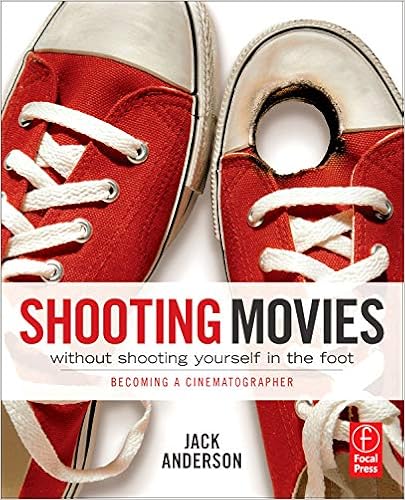
Shooting Movies Without Shooting Yourself in the Foot: Becoming a Cinematographer

PDF Download Shooting Movies Without Shooting Yourself in the Foot: Becoming a Cinematographer
If you have actually been able below, it suggests that you are able to type and also attach to the net. One more time, It suggests that web becomes one of the service that can make simplicity of your life. One that you can do now in this set is likewise one part of your effort to improve the life quality. Yeah, this website now gives the Shooting Movies Without Shooting Yourself In The Foot: Becoming A Cinematographer as one of products to check out in this current age.
Just what do you think about Shooting Movies Without Shooting Yourself In The Foot: Becoming A Cinematographer as one that we offer currently? This is a fantastic book that belongs to the upgraded lately publication to release. When lots of people attempt to get this book difficulty, you can be less complicated to join with us and also seek for it for easier methods. And this is you time to notify your friend regarding this good information. Delivering the great details about this publication to others will ease then not to obtain problem anymore, furthermore for far better details.
Now, we have to tell you little thing about the details pertaining to the Shooting Movies Without Shooting Yourself In The Foot: Becoming A Cinematographer When you truly have such particular time to prepare something or have the downtime to read a publication choose this. This is not just recommended for you. This is also suggested for all individuals on the planet. So, when you really feel love in this book, faster get it or you will be left behind of others. This is what we will inform to you regarding the factor you need to get it immediately, just in this website.
After obtaining some reasons of just how this Shooting Movies Without Shooting Yourself In The Foot: Becoming A Cinematographer, you must really feel that it is extremely appropriate for you. Yet, when you have no suggestion about this publication, it will certainly be better for you to attempt analysis this book. After reading page by web page in just your extra time, you can see how this publication will help your life.
Review
"I think this is wonderful book for all of us” jack of all trades” filmmakers out there..In hindsight I am sure my foot wishes I had read this book before I shoot my first feature.” -Dusan Sekulovic, Director "[It] tells the about the reality of filmmaking from a Cinematographer's perspective.his/her thoughts and the thoughts of those on the set, the challenges, and the intellect necessary for learning from mistakes and solving problems.” -Michael A Hofstein, Director of Photography "Finally-An Actual, Working Hollywood Director of Photography Shares his 'Inner-Door' Secrets of the Craft. This is a hard-hitting, no-holds-barred, fantastic 'Shooter's Guide' from a top professional in the Business. Call it-'The 'Hollywood Rules' for Up & Coming Directors-of-Photography'!!” -Dave A. Anselmi: Director, Producer, and Instructor, PracticalMysticProductions.com "Anderson is able to take some very complex concepts and meld them into a easily digestible dose of information that even a reader with little or no knowledge about the topic can easily understand and learn from." -Joey Goodsell, University of Southern Mississippi
Read more
Product details
Paperback: 368 pages
Publisher: Focal Press; 1 edition (September 2, 2011)
Language: English
ISBN-10: 0240814932
ISBN-13: 978-0240814933
Product Dimensions:
6 x 0.8 x 9 inches
Shipping Weight: 1.6 pounds (View shipping rates and policies)
Average Customer Review:
4.1 out of 5 stars
25 customer reviews
Amazon Best Sellers Rank:
#854,754 in Books (See Top 100 in Books)
Others have reviewed this book, and the text may be as advertised; I'm still reading and have not formed an opinion of that. However, the website URL on the book for the "companion website" leads (as of today, still) to a non-existent website. A search of the Focal Press website did not yield a website for this book. I contacted the publisher and was told by them that "at this time no website has been created. The editor of the book says one will be developed, but no release date has been provided." This is unfortunate. The product description describes a "companion website [that] showcases video samples, visual demonstrations of the exercises in the book, and further video explanations of the concepts that are better explained visually." Thus, an integral part of the book is not available. This is unfortunate.
If you haven't been on the set of a "real" motion picture, this books gives a great sense for the process, etiquette and practical requirements of making a movie with a professional crew. The only negative is the author spends a relatively great amount of time discussing traditional film and film cameras. While a new book, I think this part of the content dates it. Yes, I know. Film has more dynamic range and other attributes versus digital images. Those advantages are quickly disappearing. Other than that, fantastic book. Highly recommended.
An amusing read, explaining the details in unintimidating terms. Comprehensive at a beginner to intermediate level. I have been a cameraman for over 20 years, yet was reminded of some important precepts. The inside stories he tells about the biz are fun and instructive. Another good book for beginners is The 5 Cs of Cinemtaography, probably out of print.
If you're really interested in what a director of photography does, this is a great book for you. Covers a lot of what goes on on a set and who does what.
This book is great, but its target audience is limited. The book's subtitle is "Becoming a Cinematographer", and it'll help you to do just that. If you're going into a career in the film industry, and will be working with cameras with the intention of working your way up to be a DP, this is the book for you. If you're doing limited-budget work, and wearing multiple hats (writer/director/cameraman, etc), this book won't serve you well. It's intended to those with big bucks, and most of the tips/suggestions/advice in the book primarily apply to those working on films with a budget of a million bucks or more. The author prefers film over digital media, so there's another strike against it for anyone doing lower-budget stuff. That said, plenty of the tips do apply to anyone working the camera for a production of any size, but there are far better resources available if you're doing what you do on a shoestring.My recommended resources for lower-budget productions include:The Digital Filmmaking Handbook <-- Get this one. It's all-in-one comprehensive, and amazing. Far more practical/useful/universal information here on how to make a film if you're part of a limited-budget production, and want a thorough resource.DSLR Cinema: Crafting the Film Look with Large Sensor Video Cameras <-- This one's also good, and focuses on the role of the camera work using dSLR's. Lots of good tips here as well.
When it comes to books like this, I think it's a safe bet to say that the most pertinent question in need of answering before deciding whether or not to sink your hard earned money is if the information contained within will be useful to you or simply a rehash of things you already know. To that end, I hope to adequately summarize some of the wealth of knowledge contained here and couple it to my own experience with cinematography.I fancy myself a semi-professional still photographer and walk the line between hobbyist and qualified (having provided images for various publications throughout the years). I've dabbled in independent film as often as my work schedule has allowed and even wrote/directed a few pieces I've been pretty proud of. I've long felt that still photographers have a wide variety of useful literature (especially periodicals) at their disposal while videographers are typically left to their own devices. In fact I've often found myself taking techniques such as lens selection, light metering, and depth of field mastery found in the plethora of still photograph magazines I read and doing my best to apply them into the realm of motion-picture making. This works for the most part, until concepts such as framing moving subjects, positioning lights so that they aren't visible in pans, and deciding whether the situation calls for a dolly or Steadicam shot come into play. Then suddenly (as I have no formal training in video photography), I find myself improvising, relying upon instinct and oftentimes, just hoping for the best.Enter Shooting Movies by Jack Anderson. Coming in at 349 pages, this tome manages to pack about as much information in as any college course I'm aware of, and possibly even more in terms of life-experience shared.The author approaches the plethora of useful information presented with a casual, almost conversational style that immediately lays to rest fears of becoming overloaded. In fact by the book's conclusion it becomes painfully apparent that cinematographers (or perhaps more accurately, directors of photography) aren't given near enough recognition in general. I had never heard of Mr. Anderson prior to having picked up this book and truly that's a crime in and of itself.But let's discuss the nitty-gritty of the book itself and the material contained within. The prose itself is clearly geared toward an aspiring professional cinematographer with proper reference given to the motion picture industry unions, the proper chain of command on a production, and the step-by-step process of being interviewed for the job right on through production. I bring this up only because some of the indie films I've worked on were a far cry from the actual process of putting together a major motion picture. As such some of the information here wasn't pertinent to my needs but interesting nevertheless.The author devotes chapters to studying the script, equipment selection (from lighting to camera bodies, lenses to tripods, nothing is left to wonder)- Interestingly there are many pages devoted to the pros and cons of using film cameras versus a digital equipment and though Mr. Anderson professes a bias toward the film side (and discusses the attributes of various film stocks accordingly), he manages to present some level-headed arguments to each side of the coin.Surprisingly, this book relies minimally on photographs, instead slipping a few black & white captures about to demonstrate points of the text as needed. Particularly interesting to me were the movie stills and the scanned call sheets from actual films (in this case Starship Troopers). I can't accurately express the hours I spent studying this information in awe that with so many individuals involved in a single day of shooting, that films ever get completed at all.Perhaps most useful to aspiring cinematographers is the style by which Mr. Anderson breaks all of the information at hand down. He literally separates his chapters into a virtual schedule of the entire process from beginning to end. His 37-chapters span four parts (Preproduction, Production, Postproduction and Technicalities) and are written in such a manner where just about every possible concern (from first day jitters to worst case scenarios like a botched shot) is both presented and reasoned out. It's clear that this is an individual who learned by actually doing rather than simply studying and the ability to capitalize on his experiences is a constant throughout the book.In all, I would be lying if I said this particular book was targeted to the type of filmmaking in which I dabble and the amateur camcorder user looking to spruce up clips of the kids' birthday parties will also probably be a bit out of their league but that doesn't mean this isn't an absolutely fascinating look at the process of filmmaking for anyone and everyone. However, it's the true cinematography student/ apprentice/ wannabe who will get the absolute most out of this work. Thanks to an absolute wealth of practical knowledge coupled to a presentation that takes what could easily be construed as a very stressful job and breaks it down into a whole bunch of easily digestible chunks, this should really be required reading at the university level.
Shooting Movies Without Shooting Yourself in the Foot: Becoming a Cinematographer PDF
Shooting Movies Without Shooting Yourself in the Foot: Becoming a Cinematographer EPub
Shooting Movies Without Shooting Yourself in the Foot: Becoming a Cinematographer Doc
Shooting Movies Without Shooting Yourself in the Foot: Becoming a Cinematographer iBooks
Shooting Movies Without Shooting Yourself in the Foot: Becoming a Cinematographer rtf
Shooting Movies Without Shooting Yourself in the Foot: Becoming a Cinematographer Mobipocket
Shooting Movies Without Shooting Yourself in the Foot: Becoming a Cinematographer Kindle


0 comments:
Post a Comment